Send us your feedback
Here you can send us feedback on the Maxess-website. Please describe the problem or what’s missing in a clear way, and on what page you found the issue. Thank you so much for your help!
Can we see wear before it becomes a problem?
Using advanced X-ray methods at MAX IV and PETRA III, researchers and industry partners, Volvo Trucks, Bodycote, and RISE Research Institutes of Sweden, studied how nitrided steel surfaces respond to stress and wear. The project provided new insights into how these protective layers are built up and how they change during use, helping industry improve the durability of critical components.
Many steel components are expected to withstand years of heavy use. Parts used in trucks, industrial equipment and manufacturing systems must cope with friction, repeated loading and tough operating conditions.
To make these components more durable, manufacturers often use nitriding, a heat-treatment process that creates a hard, wear-resistant surface. In some cases, an additional oxidation treatment is added to improve corrosion resistance.
Although these treatments are widely used, there is still much to learn about what happens beneath the surface. Why do some treated surfaces perform better than others? How does wear affect the material over time? And how do the different layers work together to protect the component?
Answering these questions could help manufacturers design longer-lasting products and optimise their heat-treatment processes.
A collaboration driven by industry
The project brought together researchers, Volvo Trucks and Bodycote to investigate these challenges.
Both companies use nitriding to improve the performance of critical components and wanted to better understand how these surface layers behave in real applications. Through the BEAMS programme, the project gained access to the advanced research facilities at MAX IV in Sweden and PETRA III in Germany.
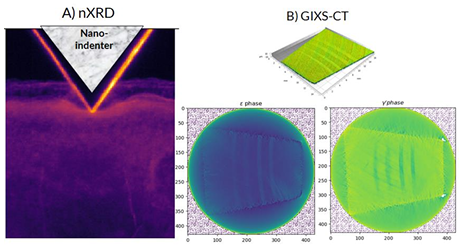
A) Strain field analysis after nano
indentation, B) GIXS-CT ε and γ’ phase distribution of a worn nitrided surface.
By combining industrial experience with cutting-edge research infrastructure, the team could explore details that are impossible to study using conventional laboratory equipment.
Looking beneath the surface
At MAX IV, researchers used highly focused X-rays together with a nano-indenter, a tool that presses a tiny tip into the material. This allowed the team to see how stresses developed inside the nitrided layers as the load increased.
At PETRA III, the researchers examined worn samples from laboratory tests and industrial components. Using an advanced imaging method, they mapped changes inside the material without cutting or damaging it.
Together, these techniques provided a unique view of how the protective surface layers respond to mechanical loading and wear.
“Inspiring to be a part of this project, performing advance investigation of one of our common heat treatment process” Lena Magnusson Åberg, Volvo
Insights for longer-lasting components
The study revealed clear differences in how nitrided layers behave under stress and after wear. Researchers successfully mapped local stress fields and identified changes in the material structure caused by different wear conditions.
The results provide valuable knowledge about how nitrided surfaces function and how heat-treatment processes influence performance. The project also demonstrated new possibilities for future studies in which wear can be monitored while it happens.
In the long term, this knowledge could help industry develop more durable components, improve surface-treatment processes and increase reliability in demanding applications.
“Advanced nXRD Redefines Nitriding Characteristics to Improve Performance in Tough Demanding Applications for Our Customers Components.”
Arvin Ghorbani, Bodycote
Support and acknowledgements
The project was carried out in collaboration with Volvo Trucks, Bodycote, MAX IV Laboratory and PETRA III. The results contribute to ongoing research in surface engineering and provide a foundation for future studies of wear and material performance. This work was made possible through BEAMS for Industry.
Contact Partners
Case Details
Volvo Trucks, Bodycote
LSRI-initiative at RISESwedish Material Science Beamline P21NanoMAXCenter for X-rays in Swedish Materials Science (CeXS)