Send us your feedback
Here you can send us feedback on the Maxess-website. Please describe the problem or what’s missing in a clear way, and on what page you found the issue. Thank you so much for your help!
Why Do Tiny Materials Have Such a Big Impact on Coating Performance?
Researchers and Provexa Technology used advanced X-ray techniques at MAX IV to investigate how graphene and MXenes are distributed within conductive coatings. The study revealed previously unseen structures inside the coatings and identified the most suitable methods for analysing them, providing valuable knowledge for improving future coating performance.
Modern coatings can do much more than protect a surface. By adding advanced materials, they can also conduct electricity, resist wear and provide other specialised functions.
Provexa Technology develops functional coatings based on polymers combined with graphene and MXenes. These are so-called 2D materials, meaning they are only a few atoms thick. Despite being added in very small amounts, they can dramatically influence the properties of a coating.
However, an important question remains unanswered: how do these tiny materials arrange themselves inside the coating, and how does that affect the final performance? Understanding this relationship is essential for developing coatings with reliable and predictable properties.
A collaboration focused on innovation
To answer these questions, Provexa Technology partnered with researchers from RISE Research Institutes of Sweden and used the advanced capabilities of MAX IV Laboratory in Lund through the BEAMS programme.
The goal was not only to study the coatings themselves but also to identify which synchrotron-based methods are capable of revealing the hidden structures that influence coating performance.
Looking inside the coating
All experiments were carried out at MAX IV on organic coatings containing either graphene or MXenes.
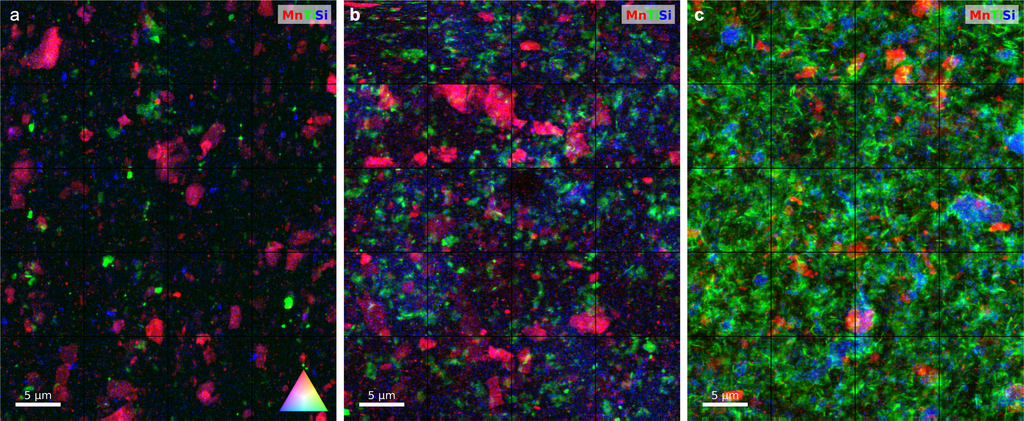
Distribution maps for Mn (red), Ti (green) and Si (blue) from X-ray fluorescence data collected with hard X-rays at NanoMAX
At the MAXPEEM beamline, researchers used soft X-ray techniques to investigate how graphene was distributed across the coating surface. These methods can provide both chemical and structural information at extremely small scales.
At the NanoMAX beamline, the team used X-ray fluorescence microscopy to examine coatings containing MXenes. Because MXenes contain titanium, this technique made it possible to track where the material was located within the coating and whether it was evenly distributed.
Together, the methods provided a detailed view of structures that cannot be seen with conventional laboratory techniques.
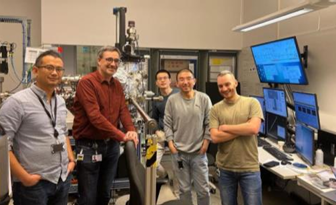
From left: Shun Yu (RISE), Christian
Werdinius (Provexa), Lin Zhu and Yuran Niu (MAX IV), Simone Sala (RISE) at the MAXPEEM beamline.
Key findings and future potential
The study showed that the soft X-ray methods were unable to detect the very low graphene concentrations used in Provexa’s commercial coatings. While these techniques remain useful for analysing carbon-based materials, they were not suitable for this particular application.
The MXene-containing coatings produced more promising results. Researchers discovered clear variations in the distribution of titanium, revealing that MXenes tend to form small clusters rather than dispersing evenly throughout the coating. The size and distribution of these clusters were found to depend on both the coating formulation and the manufacturing process.
This new understanding will help Provexa optimise how its coatings are produced and better tailor their properties to customer needs. More broadly, the project demonstrates how advanced synchrotron techniques can help industry understand the hidden structures that control material performance.
Support and acknowledgements
The project was carried out by Provexa Technology and RISE in collaboration with MAX IV Laboratory.
This project was funded by Vinnova, Sweden’s Innovation Agency.
Contact Partners
Case Details
Provexa Technology
LSRI-initiative at RISEMAXPEEMRISE X-ray photoelectron spectroscopy (XPS)NanoMAXBioMAX