Send us your feedback
Here you can send us feedback on the Maxess-website. Please describe the problem or what’s missing in a clear way, and on what page you found the issue. Thank you so much for your help!
How can advanced X-ray microscopy improve bio-based graphene?
Researchers from Bright Day Graphene, RISE Research Institutes of Sweden and MAX IV used advanced X-ray microscopy to investigate how production conditions affect lignin-based graphene. The results provide new knowledge that can help optimise manufacturing, improve product quality and identify the most suitable applications for bio-based graphene.
Understanding the challenge
Graphene is widely recognised for its unique properties and potential use in areas such as electronics, energy storage and advanced composites. Bright Day Graphene produces graphene from lignin, a renewable material derived from biomass.
The properties of this bio-based graphene depend on both the source of the lignin and the processing conditions used during production. To develop products with consistent performance, manufacturers need a better understanding of how production parameters influence the material’s structure.
Traditional laboratory techniques can provide useful information, but they often cannot reveal chemical variations at the level needed to fully understand these relationships.
Collaboration across industry and research
The project brought together Bright Day Graphene, RISE Research Institutes of Sweden and researchers at MAX IV Laboratory.
Bright Day Graphene produced the graphene materials, while RISE supplied and refined the lignin precursor. Through the BEAMS for Industry programme, the team gained access to the MAXPEEM beamline at MAX IV, a facility that combines high-resolution imaging with chemical analysis.
Researchers, company representatives and beamline scientists worked closely together throughout both the measurements and data evaluation.
A new lens on chemical structure
The project used X-ray Photoemission Electron Microscopy (XPEEM) and Low-Energy Electron Microscopy (LEEM) to study individual graphene flakes.
XPEEM combines X-ray spectroscopy and microscopy, allowing researchers to map chemical differences across a material with a spatial resolution of around 50 nanometres. By focusing on carbon and oxygen signals, the team could investigate how chemical structures varied within and between samples.
This provides information that cannot easily be obtained using conventional microscopy alone.
“Through analyzing our material at the MAXPEEM beamline we have gotten detailed information that we could not otherwise have received. Thanks to this project we are much better equipped to know which market our graphene is best suited for as well as how we can improve our quality further.”
Anna Carlsson, CTO, Bright Day Graphene AB
Key findings and scientific insights
Six graphene samples produced under different processing conditions were analysed. The measurements revealed clear differences in oxygen-containing chemical groups and showed how these variations were linked to manufacturing conditions.
By mapping chemical states across individual graphene flakes, researchers gained a detailed understanding of how processing affects the material’s structure. The results provided information that had previously been unavailable using standard laboratory methods.
Why this matters
The project gives Bright Day Graphene new tools to understand and control the production of lignin-based graphene. This knowledge will support process optimisation, improve product consistency and help identify the most promising application areas.
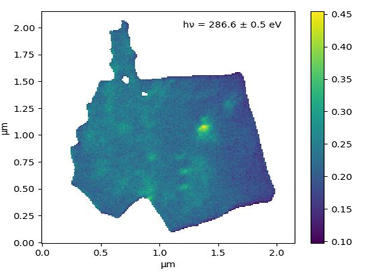
The figure shows a typical XPEEM image that corresponds to the C=O (π*) impurity contribution in the empty molecular orbitals within a single flake of lignin-derived graphene. The brighter colors show where the impurity accumulated.
More broadly, the study demonstrates how synchrotron-based X-ray microscopy can accelerate the development of sustainable advanced materials. By linking production conditions directly to chemical structure, manufacturers can make better-informed decisions and bring new bio-based technologies closer to commercial use.
This work was made possible through BEAMS for Industry.
Contact Partners
Case Details
Bright Day Graphene
LSRI-initiative at RISERISE offer within large scale research infrastructuresMAXPEEM