Send us your feedback
Here you can send us feedback on the Maxess-website. Please describe the problem or what’s missing in a clear way, and on what page you found the issue. Thank you so much for your help!
Can X-ray absorption spectroscopy help improve high-performance fibre lasers?
Researchers from NKT Photonics, Swedish Defence Research Agency FOI, Lund University and RISE Research Institutes of Sweden used advanced X-ray absorption spectroscopy at the Balder beamline, MAX IV Laboratory in Lund to gain new insights into the atomic structure of fibre laser materials. The study revealed how the local environment around the lasing ions changes with concentration and during fibre manufacturing. These findings can support the development of more efficient fibre lasers with longer service lifetimes.
Understanding the challenge
Fibre lasers play an important role in applications ranging from manufacturing and telecommunications to scientific research. Their performance depends strongly on the behaviour of the lasing ions embedded within the glass fibre.
To improve efficiency and durability, manufacturers need a better understanding of how these ions are arranged at the atomic level. One key question is whether increasing the concentration of lasing ions causes them to cluster together, which can negatively affect laser performance. However, studying these structures is challenging because the ions are present in low concentrations and are embedded in a complex glass matrix.
Industry and research working together
The project brought together NKT Photonics, a world-leading manufacturer of fibre lasers, and RISE Research Institutes of Sweden. By combining industrial expertise with advanced characterisation methods available at MAX IV, the team investigated both laser preforms and drawn fibres.
“To be able to study the local chemical structure of the lasing ion has been
interesting but challenging” Lars Norin, NKT Photonics
In addition to X-ray absorption spectroscopy measurements, the researchers used complementary techniques including Raman spectroscopy and fluorescence spectroscopy. Advanced modelling methods were also developed to analyse the complex structural data.
Looking inside fibre laser materials
The research relied on X-ray Absorption Spectroscopy (XAS) at the Balder beamline. Two complementary approaches were used.
EXAFS (Extended X-ray Absorption Fine Structure) provided information about the coordination environment and distances between atoms surrounding the lasing ion. XANES (X-ray Absorption Near Edge Structure) was used to determine the oxidation state of the ion.
Eight sets of preform and fibre samples with different compositions were analysed and compared with reference materials. A new Python-based modelling approach was also developed to improve the analysis of complex glass structures.
Key findings and future opportunities
The study found no evidence of significant clustering of lasing ions, an encouraging result for the development of high-performance fibre lasers. Researchers also observed that the ions exist in a distorted coordination environment and that the local structure depends on ion concentration.
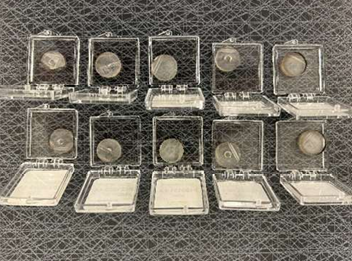
A photo of the set of preforms that were prepared for the XAS study.
The measurements revealed clear differences between preforms and finished fibres, suggesting that structural changes occur during the fibre-drawing process. In addition, the lasing ions were found primarily in the expected 3+ oxidation state.
These structural insights can later be linked to fluorescence and performance data, helping manufacturers optimise efficiency and extend fibre laser lifetime. The project demonstrates how advanced research infrastructure can provide industry with knowledge that supports the next generation of high-performance photonic technologies.
This project was funded by Vinnova, Sweden’s Innovation Agency.
Contact Partners
Case Details
NKT Photonics AB
LSRI-initiative at RISERISE offer within large scale research infrastructuresBalder