Send us your feedback
Here you can send us feedback on the Maxess-website. Please describe the problem or what’s missing in a clear way, and on what page you found the issue. Thank you so much for your help!
Can recombinant casein help create cheese without cows?
Researchers from Cassius AB and RISE Research Institutes of Sweden used advanced X-ray scattering at MAX IV Laboratory to investigate how recombinant casein forms micelles and develops cheese-like structures. The study revealed how factors such as salt concentration, protein composition and calcium influence micelle size and organisation. These insights can support the development of next-generation animal-free dairy products with improved texture, functionality and consumer appeal.
The challenge behind animal-free cheese
Demand for sustainable alternatives to animal-derived foods is growing rapidly. One promising approach is the production of dairy proteins through precision fermentation, enabling cheese-like products to be made without cows.
However, developing high-quality animal-free cheese remains challenging. Casein proteins naturally organise into microscopic structures called micelles, which are essential for the texture and behaviour of traditional cheese. Recombinant casein does not always behave in the same way as casein from cow’s milk, making it difficult to predict how it will respond during processing and cheesemaking.
To develop successful products, manufacturers need a better understanding of how recombinant casein forms micelles and how these structures change when exposed to different processing conditions.
Combining scientific and industrial expertise
The project brought together Cassius AB and RISE to explore how advanced analytical techniques can support the development of animal-free dairy products.
Researchers studied several formulations containing different ratios of alpha- and kappa-casein. The samples were analysed under varying pH conditions and salt concentrations to determine how these factors influence micelle formation and stability. By combining Small-Angle X-ray Scattering (SAXS) with complementary characterisation methods, the team was able to investigate structures that are difficult to observe using conventional laboratory techniques.
Revealing the structure of recombinant casein
The measurements were carried out at the CoSAXS beamline at MAX IV Laboratory. SAXS is well suited for studying nanoscale structures and provided detailed information about both the overall size of the micelles and the smaller calcium-casein nanoparticles that build them.
The researchers analysed recombinant casein solutions before and after treatments designed to mimic cheesemaking, including calcium addition, renneting and pH reduction. By modelling the scattering data, they could determine how processing conditions affected the organisation of the casein structures.
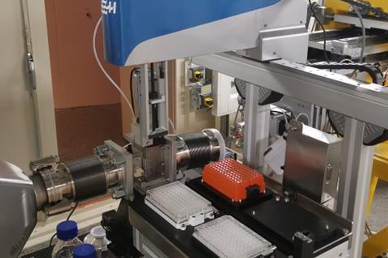
High-throughput SAXS setup at
CoSAXS, with autosampler and flow cell.
The experiments also allowed direct comparisons between recombinant casein and conventional casein derived from cow’s milk.
“SAXS-measurements are vital for us to better understand our macroscopic results and for adapting our production processes” Johan Krakau, Cassius AB
Results and future potential
The study showed that increasing salt concentration reduced micelle size, while pH had little effect. Higher levels of kappa-casein produced larger micelles but also increased sensitivity to changes in ionic strength.
After renneting and acidification, researchers observed highly ordered calcium-casein structures with characteristic dimensions of approximately six nanometres. These structures differed from those found in conventional cow-derived casein, indicating that recombinant casein forms unique microstructures.
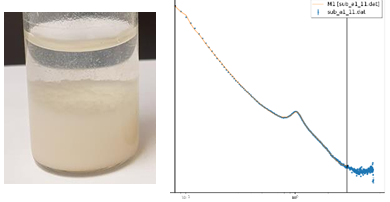
Left panel, recombinant casein
solution after renneting and lowered pH. Right panel, SAXS data from recombinant casein after renneting. The pronounced peak in the curve announces high order at a length scale of approximately 6 nm.
The results provide important knowledge for optimising animal-free cheese production and identifying processing conditions that influence texture and functionality. In particular, calcium treatment emerged as a key factor influencing the final structure.
By improving understanding of recombinant dairy proteins, the project contributes to the development of more sustainable food systems and demonstrates how advanced research infrastructure can accelerate innovation in the food industry.
This project was funded by Vinnova, Sweden’s innovation agency.
Contact Partners
Case Details
Cassius AB
RISE offer within large scale research infrastructuresLSRI-initiative at RISECoSAXSRISE SAXS/WAXS/GISAXS laboratory beamline