Send us your feedback
Here you can send us feedback on the Maxess-website. Please describe the problem or what’s missing in a clear way, and on what page you found the issue. Thank you so much for your help!
Can neutron studies lead to smarter, more durable coatings?
Using neutron reflectometry at the Institute Laue Langevin (ILL) in Grenoble, researchers from Gipeco AB and RISE Research Institutes of Sweden explored how protective coatings form and change as they dry. The study revealed how different ingredients influence the final coating structure, providing insights that can support the development of more durable, easy-to-clean and dirt-repellent surfaces.
Protective coatings are found everywhere, from painted walls and industrial equipment to surfaces designed to resist dirt, water and wear. Although these products may look simple, they are often made from a carefully balanced mixture of ingredients, each contributing different properties.
Some components improve durability, while others help the coating spread evenly during application. However, it is often difficult to understand exactly how these ingredients interact as the coating dries and forms a solid film. Small structural changes at the nanometre scale can have a significant impact on the final product’s performance.
To develop better coatings, industry needs tools that can reveal what happens inside these thin films during and after drying.
Bringing industry and research together
Through the BEAMS for Industry initiative, the team gained access to advanced large-scale research infrastructure at the Institute Laue Langevin in Grenoble, France.
Researchers from both organisations participated in the measurements and worked closely with instrument scientists at ILL. Additional laboratory-based characterisation was performed before and after the neutron experiments to build a more complete understanding of the coating system.
A new lens on coating structure
The team used neutron reflectometry, a technique that can probe extremely thin layers and reveal how materials are arranged beneath a surface. In simple terms, neutrons act like a highly sensitive probe that can look inside a coating without damaging it.
Measurements were performed using the SuperADAM reflectometer at ILL. The technique made it possible to monitor coatings immediately after application and follow how their internal structure evolved over time.
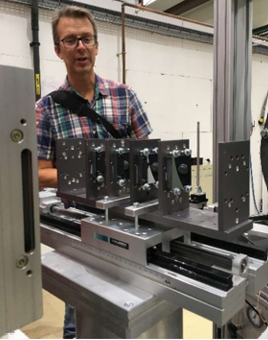
The experimental station with four samples mounted on a holder specifically modified for the needs of this experiment. Mikael Kjellin, researcher at RISE.
To complement the neutron measurements, the researchers also used X-ray scattering, profilometry and ellipsometry. Together, these methods provided valuable information about film thickness, surface quality and nanoscale structure.
Main findings and next steps
The study showed how the coating structure changes during drying and ageing. Researchers observed differences in the internal organisation of the film over timescales ranging from hours to months.
The team also investigated how replacing or adjusting specific formulation components influenced the final film structure. These experiments revealed that relatively small compositional changes can affect coating thickness and the formation of nanoscale features within the material.
The results demonstrate that neutron reflectometry can provide information that is difficult to obtain using conventional laboratory techniques alone.
The value for industry
A better understanding of coating formation can help manufacturers develop products with improved performance while reducing the need for trial-and-error formulation work.
The insights gained in this project are expected to support future improvements in wear resistance, cleanability, surface appearance and dirt-repellent properties. Beyond this specific product, the approach could also be applied to the development of new generations of coatings and surface treatments across a range of industries.
The study highlights how large-scale research facilities such as ILL can help industry understand complex materials and accelerate innovation through advanced characterisation techniques.
This project was funded by Vinnova, Sweden’s Innovation Agency.
Contact Partners
Case Details
Gipeco
LSRI-initiative at RISE