Send us your feedback
Here you can send us feedback on the Maxess-website. Please describe the problem or what’s missing in a clear way, and on what page you found the issue. Thank you so much for your help!
How does water move through sustainable paper straws?
Researchers from Tetra Pak, Lund University and RISE Research Institutes of Sweden used neutron and X-ray imaging to track water transport in paper-based materials in real time. The results provide new knowledge that can help improve the performance of paper straws and other fibre-based products.
As industries replace plastic with fibre-based alternatives, understanding how liquids move through paper materials becomes increasingly important. Products such as paper straws, paper barriers and fibre-based closures must maintain their strength while exposed to moisture.
Water transport in paper is complex. Liquids move through tiny pores, interact with fibres and cause the material to swell. To develop more robust products, manufacturers need a better understanding of these processes and how different liquids affect material behaviour.
Industry and Research Working Together
The project brought together Tetra Pak, Lund University and RISE Research Institutes of Sweden. Through the BEAMS for Industry programme, the team gained access to neutron imaging facilities at the Paul Scherrer Institute (PSI) in Switzerland and the Institut Laue-Langevin (ILL) in France as well as synchrotron x-ray tomography at ForMAX at MAX IV.
A new lens on liquid transport
The project combined neutron radiography, neutron tomography and X-ray tomography to study how liquids move through cellulose-based materials.
Neutrons are highly sensitive to water, making them ideal for tracking liquid transport inside paper structures. X-ray imaging complemented this by revealing the three-dimensional structure of the fibre network. Together, the techniques allowed researchers to observe both liquid movement and structural changes caused by swelling.
“Neutron research has huge potential in uncovering important new findings, and the industry will benefit greatly from ESS and the opportunities that the facility provides.” Joakim Tuvesson – Vice President Materials and Package, Tetra Pak
Key findings and scientific insights
Two neutron imaging campaigns were carried out using specially designed experimental setups. The measurements tracked how liquids travelled through paper strips and finished paper straws over time.
The researchers quantified liquid uptake, edge penetration and swelling in cellulose-based materials. They also explored how factors such as pH, surfactants and sugar content influence water transport.
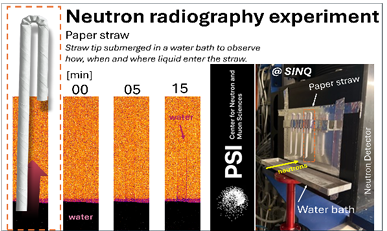
Time resolved 2D neutron radiographies showing water uptake in the paper straw (left), and the experimental setup with one of the sample environments used at the ICON instrument (right).
The combined neutron and X-ray data improved understanding of how liquid movement is linked to fibre structure. The project also provided valuable experience of neutron imaging techniques and their potential for studying soft, porous materials.
Looking ahead
The results provide valuable knowledge for developing more durable and sustainable paper-based packaging products. A better understanding of water transport can help optimise materials used for paper straws, barriers and other fibre-based applications where moisture resistance is important.
The project also strengthened collaboration between industry, academia and large-scale research facilities, creating a foundation for future research.
Conclusion
By visualising water transport in real time, the project generated new insights into how fibre-based materials interact with liquids. The knowledge gained will support future product development and help accelerate the transition to more sustainable packaging solutions.
This work was made possible through BEAMS for Industry.
Contact Partners
Case Details
Tetra Pak
LSRI-initiative at RISE4D Imaging Lab