


Send us your feedback
Here you can send us feedback on the Maxess-website. Please describe the problem or what’s missing in a clear way, and on what page you found the issue. Thank you so much for your help!
Lantmännen – a real-time study of bread during baking
In order to bake bread efficiently, without compromising on quality, the food industry needs to understand how ingredients and the baking process affect the properties of the bread. When Lantmännen wanted to investigate this in conjunction with X-ray and neutron technology, they enlisted the help of RISE and Lund University.
To meet the high consumer demand for bread and at the same time streamline the process, the food industry needs to develop its baking techniques, but without compromising on quality. Lantmännen is a leading player in grain and food production in Sweden. As a company that works both with production and research in sustainability, quality and innovation, they have an interest in improving baking techniques and understanding how ingredients and processes affect the properties of bread. Before developing new baking methods, there is a need to carefully investigate and gain a deeper understanding of how ingredients and baking processes affect the properties of bread. Lantmännen runs a number of different research projects in the field of food technology. In this project, they wanted to study the structure of bread in real time during baking, partly to give the Swedish baking industry a deeper insight into how baking technology with energy-saving potential, based on microwave heating, works. Another aim was to look at how ingredient selection affects the end result.
The project involved collaboration between RISE, Lantmännen and Lund University. The focus was on jointly investigating how two different baking techniques, one with microwave convection and one with conventional convection baking, affect the microstructure and quality of bread, which requires advanced technology and carefully designed experiments.
The choice fell on synchrotron X-ray microtomography
Analysing the structure of bread in real time is difficult because the baking process itself is complex. Traditional analytical methods, which involve taking samples for analysis at different times, would interrupt the baking process and make it impossible to track changes in a single sample throughout the baking process. Therefore, the study ended up using synchrotron X-ray microTomography to examine the structure of the bread. X-ray microTomography (μCT) is a non-destructive method that makes it possible to image the microstructure of bread. Traditional μCT can be analysed in a static state, but to image the bread in real time during the baking process, with the required temporal resolution, the X-ray flux of a synchrotron facility was needed. Therefore, the research team chose to use SRμCT, Synchrotron Radiation Micro-Computed Tomography, an advanced synchrotron radiation X-ray technique that creates high-resolution 3D images of microscopic structures.
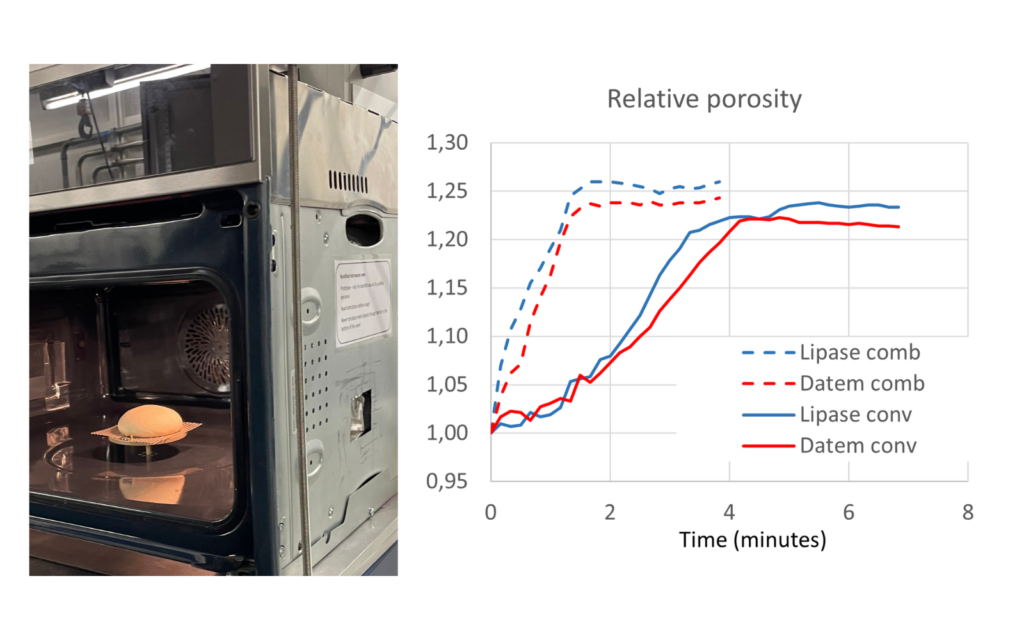
In this project, this was done by measuring how the cell structure of bread changes over time in a high spatial and temporal resolution X-ray Tomography environment, by improving previously developed measurement methods. Baking bread using microwave heating makes it possible to speed up production, and in some cases to save energy, but the rapid baking also poses challenges when analysing it. To meet these challenges, the research team had to modify a commercially available oven and also chose to carry out the experiments at the world’s fastest microTomography facility, TOMCAT at the Paul Scheller Institute in Switzerland.
Promoting innovation and strengthening the Swedish bakery industry
During the experiments, variations were used based on a basic recipe for a bread roll chosen by Lantmännen. A representative from Lantmännen participated during the tests, which helped to ensure quality and repeatability during implementation. Based on a wheat-based recipe, the ingredients were varied by adjusting the amounts of salt, oat flour, wheat fibre and whole grain. The researchers also experimented with adding DATEM and lipase. DATEM is an emulsifier and lipase is an enzyme, both used to improve the texture of bread dough.
One of the project’s sub-objectives was met as the research team was able to image the entire baking process, using both microwave and convection. By following the evolution of key parameters, such as cell wall thickness, average pore size and porosity, they gained a deeper insight into the differences between the two baking methods (combined microwave and convection baking and conventional baking). For example, it was found that combined baking produced less variation in the parameters studied by the researchers. Another observation was that the addition of the dough improvers lipase and DATEM seemed to affect pore development differently in conventional convection baking.
Ultimately, it is hoped that insights from this type of measurement will contribute to innovations and strengthen the Swedish bakery industry. This study provides some insights, but Lantmännen continues to run more research projects to develop the food industry’s baking methods.
Contact Partners
Case Details
Lantmännen
RISE Agriculture and Food

