
Send us your feedback
Here you can send us feedback on the Maxess-website. Please describe the problem or what’s missing in a clear way, and on what page you found the issue. Thank you so much for your help!
Revealing the uncharted chemistry of respiratory diseases
Using a novel application of X-ray fluorescence (XRF) at MAX IV’s NanoMAX beamline, researchers mapped the elemental make-up of lung tissue samples that may hold secrets about disease pathologies.
New horizons in respiratory diseases
Idiopathic pulmonary fibrosis (IPF) is a fatal lung disease that causes impaired breathing, fatigue, and a dry cough. Although elements including iron (Fe), zinc (Zn) and calcium (Ca) have been linked to IPF, the exact role they plan in the disease’s development is not clear.
Truly Labs, a non-clinical CRO based in Lund, has established a rodent model which reproduces many features of IPF. This model has previously been characterised at the structural and molecular levels, but not elementally. Through BEAMS for Industry (then known as MAXESS), Truly Labs was connected to MAX IV and Bryan Falcones, an expert in Lung Biology and elemental analysis by XRF.
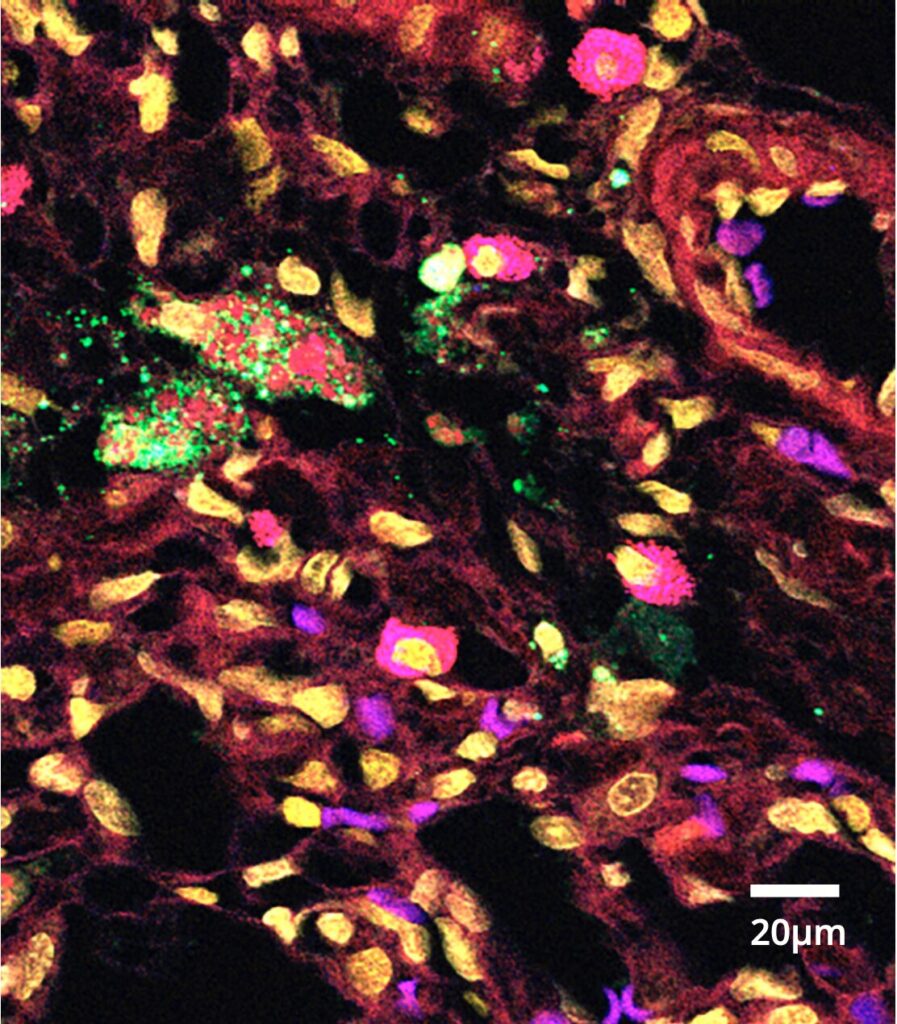
The elemental aspects of fibrosis exposed
XRF at NanoMAX highlights most periodic table elements at unprecedented nanometric resolution. Some cells under study displayed accumulations of chemical elements which is not observed in a healthy lung tissue. The implication of this and its role in the causation or development of IPF still needs to be explored and understood.
One of the unique capabilities of NanoMAX is the ability to map this elemental distribution down to the cell and even organelle level without staining the sample. The signals picked up at NanoMAX are not tainted by staining medium, but instead come directly from the elements in the sample tissue.
A bright approach to study elemental metabolism
These chemical elements, which are sometimes present in concentrations of parts per million, have fundamental roles in our bodies. Even the slightest imbalances may trigger changes in metabolism and function. The technical approach used in these experiments allowed for the study of changes within respiratory diseases which have been unexplored from an elemental perspective.
Chronic obstructive pulmonary disease, asthma and other diseases which display similar inflammatory and fibrotic behaviour as IPF may have similar elemental changes. XRF nano mapping could also be applied in these diseases where changes in elemental distribution may play a role.
This research is supported by Vinnova grant 2023-02821.
Contact Partners
Case Details
Truly Labs AB
NanoMAXTruly Labs AB